Email:export@gzliyin.com
WhatsApp:+8613902386325
Email:export@gzliyin.com
WhatsApp:+8613902386325
Dans les intérieurs modernes d'aujourd'hui — bureaux, restaurants, salles de classe, home cinémas et maisons à aire ouverte — les gens se plaignent souvent du même problème :
« J’entends des voix, mais je ne comprends pas ce que les gens disent. »
Ce problème n'est pas toujours causé par un bruit excessif. Dans de nombreux cas, il est causé par mauvaise acoustiquenotamment en cas d'écho et de réverbération excessifs. C'est là que les panneaux acoustiques deviennent une solution essentielle.
Dans cet article, nous allons expliquer comment les panneaux acoustiques améliorent la clarté de la parole, pourquoi l'intelligibilité de la parole est importante et comment des solutions professionnelles comme panneaux acoustiques à lattes de bois peut créer un environnement plus confortable et productif.
L'architecture moderne privilégie souvent le minimalisme et les espaces ouverts. Si cela est esthétique, cela engendre également des problèmes d'acoustique.
De nombreux intérieurs comportent des surfaces réfléchissantes dures telles que :
cloisons vitrées
murs en béton
planchers en bois
carreaux de céramique
plafonds apparents
grands murs vides
Ces matériaux réfléchissent les ondes sonores au lieu de les absorber. Lorsque l'on parle, la voix résonne dans la pièce et se superpose, ce qui rend la parole indistincte ou « brouillée ».
C'est ce qu'on appelle réverbération.
La clarté de la parole désigne la facilité avec laquelle les auditeurs peuvent comprendre les mots prononcés dans un espace donné. Les ingénieurs acousticiens la décrivent souvent comme suit : intelligibilité de la parole.
Dans une pièce où l'acoustique est bonne, les conversations paraissent naturelles, même à un volume de voix normal.
Dans une pièce où la clarté de la parole est mauvaise, les gens sont contraints de :
Parlez plus fort
se répéter
se sentir fatigué pendant les réunions
perte de concentration pendant les cours
mal interpréter des informations importantes
Avec le temps, cela devient un problème majeur de confort et de productivité.
Pour comprendre comment les panneaux acoustiques sont utiles, il faut d'abord comprendre les causes d'une mauvaise clarté de la parole.
L'écho est une répétition distincte d'un son causée par les réflexions de surfaces éloignées.
La réverbération est l'accumulation continue du son réfléchi dans une pièce. Elle est plus fréquente que l'écho et rend souvent les voix indistinctes.
Lorsque le temps de réverbération est trop long, les mots prononcés se chevauchent et deviennent difficiles à comprendre, notamment dans les environnements bruyants comme les bureaux, les restaurants ou les salles de classe.
Les panneaux acoustiques sont conçus pour absorber l'énergie sonore plutôt que de la réfléchir. Cela réduit les réflexions sonores et contrôle la réverbération.
Voici précisément comment ils améliorent la clarté de la parole :
Lorsque les ondes sonores frappent une surface dure (comme du verre ou du béton), elles sont renvoyées dans la pièce.
Les panneaux acoustiques réduisent ces réflexions en absorbant le son, ce qui empêche les signaux vocaux de rebondir et de se chevaucher.
Résultat: La parole devient plus nette et plus claire.
Le temps de réverbération (souvent mesuré comme RT60) correspond au temps nécessaire pour que le son s'atténue de 60 dB après l'arrêt de la source.
Dans une pièce avec un RT60 élevé, la parole est inaudible.
L'installation de panneaux acoustiques permet de réduire le RT60, créant ainsi un environnement d'écoute plus clair.
Résultat: Moins de bruit ambiant et des conversations plus intelligibles.
Dans un environnement bruyant, l'auditeur doit distinguer la parole du bruit de fond. Cela dépend fortement de la rapport signal/bruit.
Lorsque les panneaux acoustiques absorbent les réflexions, ils réduisent l'accumulation de bruits indésirables dans l'espace.
Résultat: Les voix se détachent plus nettement des bruits ambiants.
Dans les pièces à l'acoustique médiocre, les gens élèvent inconsciemment la voix pour se faire comprendre. Cela entraîne une fatigue vocale, notamment dans les cas suivants :
bureaux ouverts
salles de classe
restaurants
salles de réunion
Le traitement acoustique contribue à réduire le besoin de crier.
Résultat: Un meilleur confort pour les employés, les enseignants et les visiteurs.
La clarté de la parole n'est pas seulement une question de confort ; elle a un impact sur les performances, la sécurité et l'expérience client.
Une mauvaise clarté de la parole entraîne :
réunions inefficaces
erreurs de communication
productivité réduite
stress et fatigue mentale
Les panneaux acoustiques aident les bureaux à créer un environnement professionnel où les gens peuvent communiquer clairement.
De nombreux clients quittent les restaurants car ils trouvent l'ambiance trop bruyante. Même lorsque le niveau sonore n'est pas extrême, la réverbération peut rendre les conversations difficiles.
Les panneaux acoustiques réduisent la réverbération et améliorent l'ambiance de la salle à manger.
Une meilleure clarté d'élocution = une meilleure satisfaction client.
Les élèves doivent comprendre clairement les enseignants. Dans les salles de classe où la réverbération est importante, les enfants ont du mal à se concentrer et les enseignants doivent parler plus fort.
Les panneaux acoustiques contribuent à créer un environnement d'apprentissage efficace.
Les hôpitaux et les cliniques ont besoin d'une communication claire entre le personnel et les patients. Une mauvaise acoustique peut accroître le stress et entraîner des malentendus.
Les panneaux acoustiques améliorent la confidentialité et la clarté de la parole dans les salles de consultation.
La clarté des dialogues est essentielle lorsqu'on regarde des films. Si les dialogues sont inaudibles, on augmente le volume, ce qui crée un inconfort.
Les panneaux acoustiques peuvent améliorer la qualité sonore et la clarté des dialogues.
Il s'agit d'une confusion fréquente.
améliorer le son à l'intérieur d'une pièce
réduire l'écho et la réverbération
améliorer la clarté de la parole
réflexions de contrôle
bloque le son entrant/sortant d'une pièce
nécessite des matériaux de construction lourds
se concentre sur l'isolement plutôt que sur la clarté
Pour améliorer la clarté de la parole, Les panneaux acoustiques sont la solution adéquate.
Différents matériaux et structures influent sur les performances acoustiques.
Ces panneaux absorbent bien les fréquences moyennes et hautes, améliorant ainsi la clarté de la parole. On les trouve couramment dans les bureaux et les écoles.
Léger, écologique et efficace pour les intérieurs commerciaux.
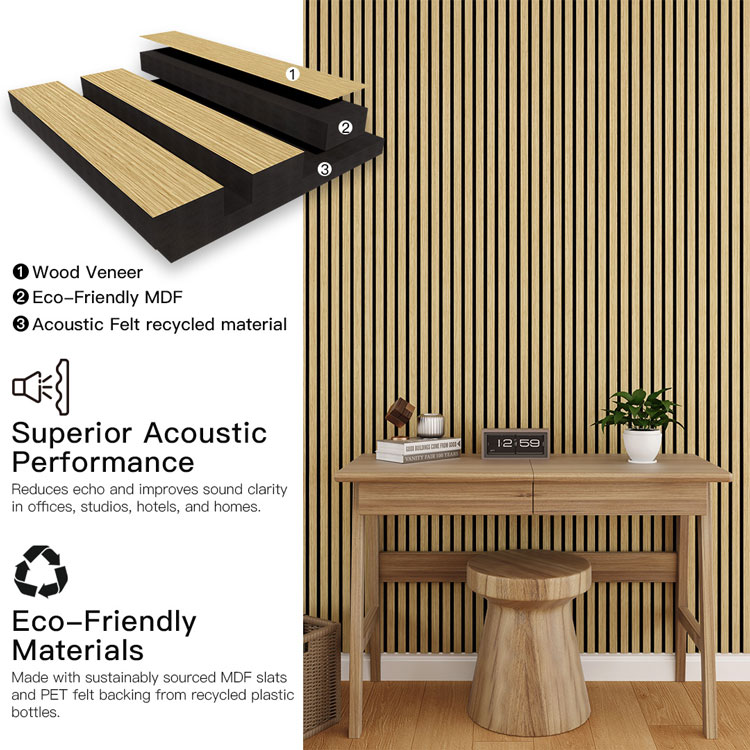
Les panneaux à lattes de bois allient esthétique et performance acoustique. Les lattes, associées à un support en feutre acoustique, absorbent les réflexions sonores.
Ils sont particulièrement populaires dans :
bureaux
restaurants
hôtels
salles de conférence
espaces commerciaux
intérieurs résidentiels modernes
Oui. panneaux acoustiques à lattes de bois sont très efficaces en améliorant la clarté de la parole lorsqu'il est correctement conçu.
Ils fonctionnent en combinant :
lattes de bois (pour la diffusion et la conception)
support en feutre acoustique (pour l'absorption)
Isolation optionnelle derrière les panneaux (pour des performances accrues)
Cette combinaison réduit les reflets tout en préservant une apparence architecturale haut de gamme.
Contrairement aux solutions en mousse classiques, les panneaux à lattes de bois conviennent aux environnements commerciaux car ils sont :
durable
facile à entretenir
visuellement attrayant
hautement personnalisable
Le positionnement est crucial. Même des panneaux de haute qualité ne fonctionneront pas correctement s'ils sont mal installés.
plafonds dans les espaces ouverts
murs derrière les zones de sièges
murs latéraux des salles de réunion
murs face aux fenêtres vitrées
zones proches des sources de bruit (cafés, restaurants, imprimantes de bureau)
Une approche professionnelle courante consiste à traiter premiers points de réflexion, où le son est renvoyé directement dans la zone d'écoute.
Il n'existe pas de solution unique, mais dans la plupart des cas, améliorer la clarté de la parole nécessite de traiter :
20 % à 35 % de la surface totale des murs et des plafonds
Les espaces comportant des surfaces dures et de hauts plafonds peuvent nécessiter :
35 % à 50 % couverture pour des résultats optimaux
L’objectif est de réduire la réverbération sans que la pièce ne sonne « trop étouffée ».
Lors du choix de panneaux acoustiques pour une meilleure clarté de la parole, tenez compte des facteurs clés suivants :
Les panneaux plus épais absorbent davantage les sons de basse fréquence, mais la clarté de la parole dépend principalement du contrôle des fréquences moyennes.
Les matériaux de base de haute qualité assurent une absorption stable et des performances durables.
L'indice NRC indique la quantité de son absorbée en moyenne par un panneau. Un NRC plus élevé signifie généralement une meilleure réduction de l'écho.
Le montage direct sur les murs par rapport à l'utilisation d'un espace d'air peut affecter les performances d'absorption.
À Acoustique Leeyin du GuangdongNous sommes spécialisés dans la fabrication de produits haut de gamme. panneaux muraux à lattes de bois et panneaux acoustiques pour des projets résidentiels et commerciaux internationaux.
Nous sommes l'un des principaux exportateurs chinois de panneaux acoustiques à lattes de bois, assurant un approvisionnement fiable aux importateurs, grossistes, entrepreneurs et architectes d'intérieur du monde entier.
usine de production moderne de 20 000 m²
forte capacité de production de masse pour les projets de grande envergure
Un contrôle qualité rigoureux basé sur les normes internationales
finition de placage stable et alignement régulier des lattes
couleurs, tailles et emballage personnalisables
soutien logistique prêt à l'exportation pour les marchés mondiaux
Que votre projet nécessite une conception acoustique moderne pour des bureaux, des espaces hôteliers ou des intérieurs de maison, nous proposons des solutions professionnelles qui combinent performances sonores et architecturales
MOTS CLÉS :

Tél / Whatsapp : +86 13902386325 / +86 13902386325
E-mail
:
export@gzliyin.com


© 2026 Technologie Cie., Ltd d'acoustique de Guangdong Liyin. Tous droits réservés.

Hi! Click one of our members below to chat on


